
admin

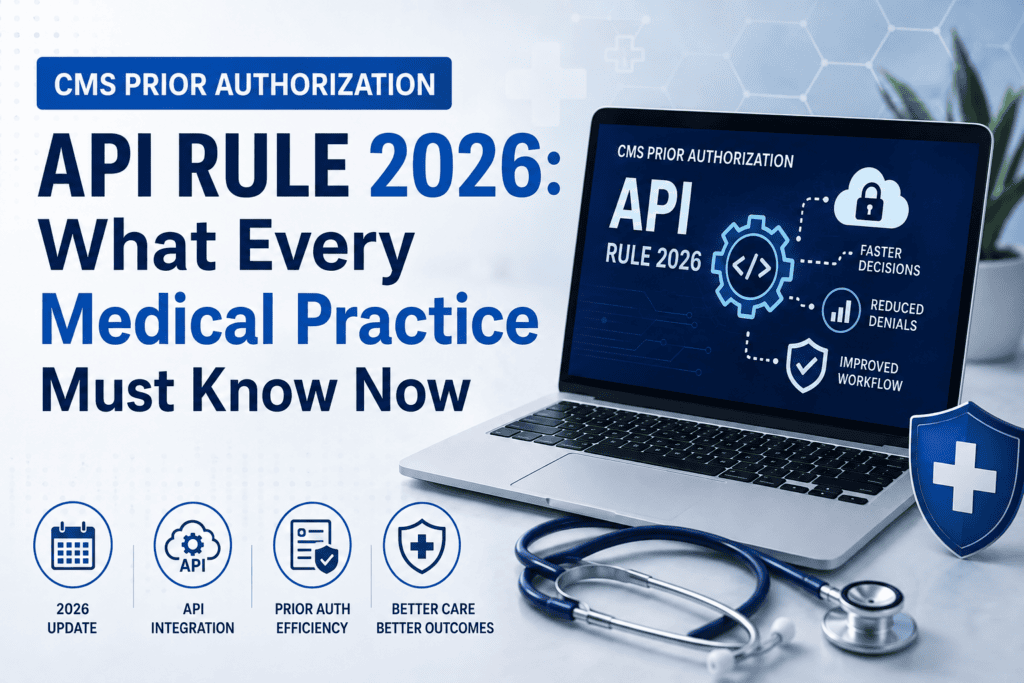
CMS Prior Authorization API Rule 2026: What Every Medical Practice Must Know Now

If you run a medical practice, you already know prior authorization is one of the most expensive, most frustrating parts of your day — fax machines, hold music, and a stack of requests waiting on a payer to say yes. That’s about to change, and the reason has a name: the CMS Prior Authorization Rule 2026. Officially called CMS-0057-F, this is CMS’s biggest push yet toward electronic prior authorization. Some parts of the rule are already reshaping how payers operate. Others — the technical backbone built on HL7 FHIR — don’t fully land until 2027. If your practice hasn’t mapped out what applies to you and when, now is the time— our medical billing services team can help you get ahead of it. This guide covers exactly what CMS-0057-F requires, who it applies to, the real 2026-vs-2027 timeline, and what your practice should be doing today to stay ahead of it. What is the CMS Prior Authorization Rule 2026? CMS-0057-F, finalized in January 2024, is CMS’s formal push to modernize prior authorization in healthcare using standardized technology instead of phone calls and fax forms. The goal is simple: make prior authorization faster, more transparent, and less of a burden on both patients and providers. Under the rule, impacted payers must: In plain terms: this is the shift from “call and wait” to a connected, software-driven authorization process — and it’s the biggest step toward true electronic prior authorization the industry has seen. Who CMS-0057-F Applies To The payer prior authorization requirements under this rule cover: Traditional fee-for-service Medicare and most employer-sponsored commercial plans aren’t directly bound by CMS-0057-F, though many national payers are aligning their systems across all product lines anyway — building two separate infrastructures is inefficient for them. Still, don’t assume: check with each payer in your mix to confirm which of their plans fall under the rule, or lean on our insurance services team to track it for you. The 2026 vs. 2027 Timeline This is where most confusion happens. CMS-0057-F rolls out in phases — here’s the breakdown. Phase one: faster decisions and real denial reasons — January 1, 2026 Starting in 2026, impacted payers must meet new deadlines: They must also give a specific reason for every denial — a direct upgrade for practices tired of vague denial codes that leave billing teams guessing. This one change alone should meaningfully cut down on unnecessary appeals. Phase two: public reporting — by March 31, 2026 Impacted payers must publicly post their prior authorization performance data from the prior year. The first report — covering 2025 data — is due by March 31, 2026, and becomes an annual requirement after that. For the first time, practices get standardized, comparable data on which payers approve quickly and which ones drag their feet. Phase three: the FHIR API goes live — January 1, 2027 The headline piece — a fully functioning HL7 FHIR standard Prior Authorization API — was originally proposed for 2026 but was pushed to January 1, 2027, giving payers and EHR vendors more time to build and test. This is also when Provider Access APIs and Payer-to-Payer data exchange become mandatory. Bottom line: 2026 is about faster clocks and honest denials. 2027 is when prior authorization actually becomes a real-time, software-connected process. Practices that wait until late 2026 to prepare for the API shift will be scrambling. Why This Matters for Your Practice’s Bottom Line It’s tempting to file this under “payer compliance, not my problem.” Don’t. Here’s why it directly touches your revenue cycle. Tighter turnaround times change your staffing math. A 7-day standard window means your prior authorization team’s follow-up cadence and escalation triggers need rebuilding around the new clock. Specific denial reasons speed up your appeals. Instead of guessing at prior authorization denial reasons, your billing team can act immediately — shortening the revenue cycle and cutting write-offs. Public metrics give you leverage. Once payer performance data is public, you can see which payers in your market consistently take longest or deny the most. That’s a real data point for contract renewals. EHR-integrated authorization is coming whether you’re ready or not. Once the 2027 API requirement is live, practices still running manual fax-based workflows will fall behind those with true electronic prior authorization built into their EHR. Faster approvals mean faster time-to-treatment and fewer scheduling gaps. There’s also a direct financial incentive: CMS added a new prior authorization compliance measure under MIPS Promoting Interoperability (and a parallel measure for hospitals) that rewards providers for using electronic prior authorization. That’s real money tied to getting ready early. What Your Practice Should Do Right Now 1. Audit your payer mix against the rule Go through your top payers by claim volume and flag which ones are impacted under CMS-0057-F — especially Medicare Advantage prior authorization plans, Medicaid/CHIP managed care, and marketplace QHP issuers. That tells you exactly where the new deadlines apply starting in 2026. 2. Ask your EHR vendor for their FHIR roadmap Ask directly: “What’s your plan for HL7 FHIR connectivity ahead of January 1, 2027?” A vague answer in mid-2026 is a red flag. Vendors that are already piloting FHIR-based workflows will put you ahead of practices scrambling in Q4 2026. 3. Rebuild your follow-up workflow around the new clock If your team’s current cadence assumes multi-week waits, shrink it to match the 72-hour/7-day standard, with automatic flags for anything that crosses the deadline. 4. Standardize how you log denial reasons Once payers must give specific prior authorization denial reasons, make sure your billing team has a structured place to capture them — not buried in a scanned letter. This becomes valuable pattern data (e.g., one payer consistently denying one CPT code for a fixable documentation gap). 5. Start tracking payer performance once it’s public When the first metrics report lands by March 31, 2026, build a simple internal comparison of your major payers on approval rates and speed. Use it in contract renewal conversations. 6. Train staff in phases — not the week before a deadline Whether it’s new turnaround expectations in 2026 or a new electronic workflow

Read more

CMS prior authorization API rule 2026: what every medical practice must know now

Prior authorization has been the single biggest source of administrative drag in American healthcare for over a decade. Fax machines, hold-music-filled phone calls, and lost paperwork have cost practices billions of dollars in staff time and delayed patient care. That is finally changing — and the change has a name every practice manager, biller, and physician needs to know: the CMS Prior Authorization API Rule 2026. Formally known as CMS-0057-F, the CMS Interoperability and Prior Authorization Final Rule was finalized in January 2024, but 2026 is the year its real-world impact hits your front desk, your billing team, and your EHR. Some obligations are already live. Others land on January 1, 2027. If your practice hasn’t mapped out what applies to you and when, this is the moment to do it. This guide breaks down exactly what the rule requires, who it applies to, the 2026 vs. 2027 timeline, and — most importantly — what your practice should be doing right now to stay compliant, protect revenue, and avoid falling behind competitors who are already automating. What Is the CMS Prior Authorization API Rule 2026? The CMS Prior Authorization API Rule 2026 is shorthand for the operational and technical requirements under CMS-0057-F that take effect starting in 2026, with full electronic prior authorization API infrastructure required by 2027. The rule builds on the 2020 CMS Interoperability and Patient Access final rule and is designed to force payers toward faster, more transparent, and electronically automated prior authorization decisions. At its core, the rule requires impacted payers to: Build a standardized Prior Authorization API using the HL7 FHIR standard, so provider systems can check whether a service needs authorization, see what documentation is required, and submit requests electronically. Send authorization decisions back through a structured, machine-readable format instead of a fax or PDF letter. Provide a specific reason when a prior authorization request is denied. Meet shorter decision turnaround times. Publicly report prior authorization metrics on an annual basis. For practices, the promise is fewer phone calls, faster answers, and — eventually — prior authorization checks that happen directly inside your EHR workflow instead of a separate portal or fax queue. Who the Rule Applies To CMS-0057-F applies to “impacted payers,” which includes: Medicare Advantage (MA) organizations State Medicaid Fee-for-Service (FFS) programs State Children’s Health Insurance Program (CHIP) FFS programs Medicaid managed care plans CHIP managed care entities Qualified Health Plan (QHP) issuers on the federally facilitated exchanges (FFEs) Note what’s not automatically included: traditional fee-for-service Medicare and commercial employer-sponsored plans outside the ACA marketplaces are not directly bound by this rule in the same way, though many national payers are voluntarily aligning their systems across product lines because building separate infrastructure for each product line is inefficient. Practices should confirm directly with each payer which of their plans fall under CMS-0057-F obligations, since payer mix varies widely by specialty and geography. The 2026 vs. 2027 Timeline: What’s Already Live and What’s Coming This is where a lot of confusion happens, because the rule has two distinct waves of requirements. Getting this timeline straight is the difference between being caught off guard and being ready. Phase One: Operational Requirements — January 1, 2026 Starting in 2026, impacted payers must meet new prior authorization turnaround time standards: 72 hours for expedited/urgent requests 7 calendar days for standard requests Payers must also provide a specific reason when denying a prior authorization request — no more vague denial codes that leave your billing team guessing. This alone should meaningfully reduce the appeals workload for practices that have been fighting denials with incomplete information. Phase Two: Public Metrics Reporting — By March 31, 2026 Impacted payers must publicly post aggregated prior authorization metrics from the prior calendar year on their websites. The first public report, covering 2025 data, is due by March 31, 2026, and this becomes an annual requirement going forward. Metrics include things like approval and denial volumes and average decision times, reported at the contract, state, plan, or issuer level depending on payer type. This is a big deal for practices doing payer selection or renegotiating contracts — for the first time, you’ll have standardized, comparable data on which payers actually approve prior authorizations quickly and which ones don’t. Phase Three: The Prior Authorization API — January 1, 2027 The headline requirement — a functioning, FHIR-based Prior Authorization API that allows electronic submission and structured decision responses — was originally proposed for 2026 but was pushed to January 1, 2027 in the final rule, giving payers and EHR vendors more runway to build and test connections. This is also when Provider Access APIs and Payer-to-Payer data exchange requirements become mandatory for impacted payers. The practical takeaway: 2026 is the year of tighter deadlines and denial transparency. 2027 is the year prior authorization becomes a real-time, electronic workflow instead of a manual one. Practices that wait until late 2026 to prepare for the API transition will be scrambling. Why This Matters for Your Practice’s Revenue Cycle It’s easy to file this under “payer compliance, not my problem.” That would be a mistake. Here’s why: Faster turnaround times change your scheduling and staffing math. A 7-day standard decision window (down from what is often weeks in practice) means your prior auth team’s workflow, follow-up cadence, and escalation triggers all need to be rebuilt around the new clock. Specific denial reasons mean faster, cleaner appeals. Instead of guessing why a claim was denied, your billing team can act immediately, which shortens the revenue cycle and reduces write-offs. Public metrics create payer accountability — and leverage. When you can see which payers in your market consistently take the longest or deny the most, that becomes a data point in contract negotiations and even in how you counsel patients about plan selection. EHR-integrated prior authorization is coming whether you’re ready or not. Once the 2027 API requirement is live, practices still relying on manual fax-based workflows will be at a structural disadvantage compared to those who’ve integrated

Read more

AI in Medical Billing: How Automation is Slashing Claim Denials by 28% in 2026

The healthcare industry crossed the digital tipping point in the first half of 2026. When payers adopted more sophisticated AI-driven algorithms to audit submissions, medical practices faced an unprecedented wave of AI in medical billing claim denials. Manually managing traditional revenue cycles today is not only slow, but a huge drain on your finances.Strategic Revenue Cycle Management automation has become a key line of defense for today’s healthcare systems in response. First users of Agentic AI healthcare tools—systems that can think and carry out complex billing functions independently—are experiencing a 28% average reduction in claim rejections. This change is pushing the industry away from reactive corrections and into proactive revenue integrity. 2026 Denial Crisis: Why Manual RCM is Not Sustainable Medical coding and compliance has become exponentially more complex. With the introduction of thousands of new diagnostic variations and increased “Medical Necessity” requirements from the major payers, the margin for human error is now zero.Traditional strategies and not modern RCM automation 2026 practices can take up to 20 minutes to manually verify one complex claim by your billing specialist. If a claim is denied, the cost of “rework” will often be more than $65 per case in 2026. High denial rates are a huge leak in the revenue bucket, and they prove that practices that don’t embrace automation are paying a high “manual tax” on every patient visit. Technical Architecture: How Agentic AI is Different from Basic RPA In the past, “automation” was just Robotic Process Automation (RPA) – macros moving data from A to B. Today, the integration of Agentic AI healthcare workflows changes everything. Advanced systems use cognitive processing to determine the root cause of an error code, where RPA will fail at the first change in payer portal layout. It recognizes not just a denial, but that a particular denial requires clinical documentation from the patient record. The system can then retrieve that documentation on its own, check it against changing payer rules and attach it to an appeal without human intervention. This is the cognitive capability that enables the technology to link the dots between clinical data and financial outcomes. The Role of Predictive Analytics in Pre-Submissions The best way to deal with a rejection is to avoid it altogether with predictive denial management. Modern platforms act as a “Pre-Submission Auditor,” scrubbing claims with a level of depth that was previously impossible. Real-Time Eligibility (RTE): Automates insurance verification 24 hours prior to an appointment to confirm active coverage matches the scheduled procedure exactly. Smart Claim Scrubbing: AI models trained on billions of historical claims with 98% accuracy can predict denial based on the unique combination of provider, payer and procedural records. Automated Medical Coding: By reading clinical notes directly, AI assigns codes that follow the latest guidelines. This process removes the mismatches in transcripts that cause administrative rejections and improves your clean claim rate based on 2026 benchmarks. Solving the Interoperability Challenge: EHR to Payer A major obstacle in cutting financial losses is the disconnected nature of administrative data. AI-driven Revenue Cycle Management automation works best with connectivity. By using modern API integrations, automation tools can connect your Electronic Health Record (EHR) and the insurance payer’s secure portal. This smooth data flow ensures that documentation stays intact from the initial doctor’s note to the final payment remittance. When data flows cleanly at the source, achieving a high clean claim rate 2026 standard becomes an attainable operational baseline rather than an optimistic goal. Compliance & Security: Navigating HIPAA in 2026 With more automation comes greater responsibility for data privacy. Implementing AI solutions must follow “Zero-Trust” architectures to make sure patient privacy is always protected. Data De-identification: Modern tools handle billing data while keeping Personal Health Information (PHI) encrypted or removed from the main learning models. Immutable Audit Trails: Automated systems create a digital record for each action taken on a claim. This is crucial for compliance and speeds up internal financial audits, making them much more accurate. Case Study: The 28% Transformation Consider a multi-specialty clinic that processes 5,000 claims each month. Before they used automated predictive denial management, their denial rate was around 12%, which amounted to 600 claims. After they added an AI-driven pre-audit and automated medical coding layer. Initial Denials: Dropped to 8.6%, representing a 28% relative reduction in overall errors. Revenue Recovered: Approximately $42,000 in monthly “trapped” capital was released directly back into the practice’s active cash flow. Staff Morale: Billing teams moved away from tedious data correction to focusing on strategic revenue optimization and patient advocacy. Conclusion: Making the Shift with MCKIOL Successfully mitigating AI in medical billing claim denials is not just a statistical victory; it is the difference between a practice that is surviving and one that is thriving. As the year progresses, the competitive gap between automated and manual practices will only widen. At MCKIOL, we provide the specialized, no-code, and AI-driven infrastructure to ensure your revenue cycle is future-proof, compliant, and optimized for maximum financial recovery.

Read more

Outsourced Medical Billing Made Simple – Advantages of Partnering with MCKIOL

Running a healthcare practice isn’t easy. Doctors want to focus on patients, but endless billing tasks, claim rejections, compliance rules, and revenue leaks often get in the way. The result? Stressed staff, delayed payments, and frustrated patients. This is where outsourcing comes in—and when you choose MCKIOL, medical billing becomes smarter, faster, and stress-free. With over 25 years of healthcare outsourcing expertise, MCKIOL has helped global hospitals, clinics, and practitioners turn billing into a profit-driven, hassle-free process. Let’s dive into the real benefits. Why Healthcare Providers Outsource Medical Billing If you’re handling billing in-house, you’ve likely faced: 👉 The truth is, Medical Billing Services is not just paperwork—it’s the financial engine of your practice. If it’s not managed properly, your revenue suffers. By outsourcing to experts like MCKIOL, you protect your revenue cycle and free your team from unnecessary stress. Advantages of Partnering with MCKIOL Here’s how MCKIOL transforms medical billing into a seamless, revenue-boosting process: 1. Accelerated Payments & Healthy Cash Flow We ensure every claim is submitted correctly and on time, while actively following up on denials. That means you get paid faster and more consistently. 2. Massive Cost Savings Forget the high costs of in-house billing teams, software, and compliance management. With MCKIOL, you save up to 40% on operating costs while accessing top-tier expertise. 3. Compliance Without Worry Healthcare rules change constantly. Our team stays ahead with HIPAA, ICD-10, CPT, and payer-specific guidelines so your practice stays fully compliant—always. 4. Error-Free Billing & Higher Claim Approvals Every claim undergoes multi-step quality checks and coding audits. The result? Fewer rejections, fewer delays, and more money in your account. 5. More Time for Patients, Less Time on Paperwork When billing is handled by MCKIOL, your doctors and staff can finally do what they do best: care for patients and grow your practice. 6. Flexible & Scalable Services From small clinics to large hospitals, our solutions scale with your needs. Whether you’re starting out or expanding, MCKIOL grows with you. 7. Technology That Works for You We use cutting-edge billing software, automation tools, and real-time reporting dashboards. You get complete visibility into your revenue cycle—no hidden surprises. 8. 24/7 Global Support Healthcare doesn’t sleep, and neither do we. With global teams and round-the-clock support, your billing cycle never slows down. The Real-World Impact Healthcare providers that outsource to MCKIOL typically experience: It’s not just outsourcing—it’s a transformation in how your practice operates. Why MCKIOL Stands Out With decades of experience and a reputation for excellence, MCKIOL is more than a vendor—we’re a long-term partner for your financial success. ✅ 25+ years of healthcare outsourcing expertise✅ Trusted by global hospitals, clinics, and practitioners✅ Transparent pricing with no hidden fees✅ Dedicated account managers for personalized support When you work with MCKIOL, you gain peace of mind, higher revenue, and more time for what matters most—your patients. Final Thoughts Medical billing doesn’t have to be complicated, costly, or stressful. By outsourcing to MCKIOL, you unlock: 🚀 Outsourced medical billing, made simple. 👉 Partner with MCKIOL today and turn your billing challenges into a growth opportunity. ✨ I can also design a call-to-action banner line like:“Let MCKIOL handle your billing, so you can handle healthcare.”

Read more
insurance-verification

How to Make Insurance Verification Easy for Your Clients

Have you ever had that sinking feeling when a client says, “Will my insurance pay for this?” Or worse, you only find out after the service is provided that their coverage isn’t what you thought it was? This is a common pain point in every industry, but particularly in healthcare. Trying to navigate through a jungle of insurance verification documents, policies, deductibles, co-pays, and eligibility can be a misappropriation of your time, dollars, and your client’s trust! But imagine, if you could make that entire process, dare we say, fun? Or, at the very least, truly seamless? This is more than avoiding denials, it’s about creating an easy, stress-free experience for your clients right from the first point of contact, and ensuring compensation for your business is easy and timely. Let’s dig in on how to create a seamless insurance verification process. Why a Seamless Insurance Verification Process is a Game-Changer A seamless insurance verification process is not only seen as busywork; it is a key factor to both your client experience and your financial health. Here are the benefits that make it a game-changer: Best Practices for an Easy Insurance Verification So, how do you turn a potentially messy process into a truly seamless insurance experience? It’s just about using some savvy and the right resources: MCKIOL: Your Partner for a Stress-Free Insurance Verification Process While these preferred practices may seem simple they can be difficult to do consistently and while doing your core business. The amount of time spent on manual calls, logging into payer portals, and trying to find out where the missing information is coming from is very time-consuming for in-house employees. MCKIOL is here to help. We are your expert outsourcing partner that will turn the insurance verification process from being a bottleneck to smooth sailing. We are an extension of your business, performing all of the intricacies of eligibility verification efficiently: Conclusion At MCKIOL, we recognize that a seamless insurance verification process is key to client satisfaction as well as the overall financial success of your organization; hence, our commitment to outsourcing services to help you operate efficiently and effectively without worry. Just as our partners, KHP REMOTE FTE help businesses create high-performing remote teams in everything from a myriad of career functions, MCKIOL provides the operational support for service providers to successfully develop processes to optimize their growth in their particular market. If you want to remove billing headaches and provide your clients with a truly seamless insurance experience, stop letting the verification messiness slow your team down. Contact MCKIOL now for a chat about how our outsourced expert services can simplify your insurance verification process and impact your bottom line! Check out our other blogs, i.e., That Insurance Headache? Here’s How to Finally Fix It.

Read more
seo-for-doctors

SEO for Doctors: How to Get Found By Patients Online

Let’s discuss how seo for doctors is important and how patients will find you. When someone has a sniffle, a nagging ache, or they are looking for a new specialist, what is the first thing they usually do? You know the answer. More often than not, they go to Google searching for “best cardiologist near me,” or “pediatrician for kids,” or “dermatologist with the least wait time” when they need a healthcare provider. If, when you search for those terms, your practice does not come up prominently in the search results, then you will lose an opportunity to be discovered by a huge number of potential patients. This is where SEO for doctors comes into play. Fundamentally, Search Engine Optimization is simply making it easier for people in need of your services to find your website and contact you. It is about making sure your digital doorway is wide open, well lit, and directing patients to the front of your practice. Like all things in life, it doesn’t have to be complex, and you do not need a technology degree to understand or implement strategies that can have a real impact on how many patients you are acquiring. Why “Google-ability” Matters For Doctors Today The days of simply having your name in a directory or having a colleague refer you to a patient are gone. Referrals are still important, but the physical/digital landscape has shifted patient behavior. Below is the critical thinking behind why having strong healthcare SEO is important for all medical practices: Patients Start Online: Research has shown, in multiple studies, that when a patient is looking for a doctor, the vast majority of chances are that they will start with a search engine. If you are not there, you are out of luck. Trust & Authority: When patients find your practice high in search results, it creates trust. High search results build authority. Patients are more likely to trust practices that perform well on Google. Local Dominance: Nearly all healthcare searches are situated in a local context – “doctor in Delhi,” etc. Local SEO for doctors allows doctors to use geographically driven searches in patients’ searches, allowing you to appear in front of patients right in your area. Competitive Advantage: Your competitors are likely investing in medical SEO so if you aren’t, they gain a notable edge over you in patient capture. Cost-Effective Patient Acquisition: When compared with traditional advertising methods, medical SEO for doctors can generate exponentially higher ROI over time, providing a steady stream of qualified leads. SEO Strategies Which Get Doctors Found Online Now what? How do you make your practice a Google magnet? Here are several healthcare SEO strategies that help patients find you: MCKIOL: Streamline Your Journey to Online Visibility Integrating these strategies for SEO for doctors requires consistent effort, specialized knowledge, and continual oversight – things you, as a healthcare professional, do not necessarily have. Trying to actively navigate complex healthcare SEO while managing a busy practice and focusing on patient care can be overwhelming. This is exactly the role that MCKIOL is here to fulfill. We offer expert outsourcing services and committed support teams that will help your medical practice fulfill its digital marketing strategies without increasing the resources required by in-house staff. We can provide professionals to: CONCLUSION At MCKIOL, we realize that medical marketing comes with its own challenges, as does securing online visibility for prospective patients. We are invested in offering outsourcing options that empower your practice to effectively use the internet in helping you connect to more patients and reach. Just like our partners at KHP REMOTE FTE assist businesses in developing high-performing remote teams for numerous functions, MCKIOL provides health care providers the operational support needed to thrive in their own unique market. Are you ready to make sure your practice can be found by patients online and really start using SEO for doctors? Don’t allow your valuable services to remain hidden. Get in touch with MCKIOL today to learn more about how our outsourcing services can enhance your healthcare SEO and allow you to connect with more patients through the digital door. Check out our latest blog to learn how to make a strong online presence for your healthcare practice    

Read more

How to Optimize Legal Document Management

Let’s start by being honest – documents in a law firm are like the air we breathe – required, everywhere, and sometimes, a bit suffocating!. The amount of documentation (physical or digital) that law offices generate daily is immense (case files, contracts, retention of client conversations, court filings, etc) and can feel like a tsunami coming your way. If you are spending more time looking for documents than planning for your clients, you need to rethink your legal document management. But don’t worry! I’m not here to tell you just “be more organized”. I want to show you the best practices and smart solutions that truly optimize your processes to enhance law firm efficiency and allow your legal professionals to focus on high-value work. Why Effective Legal Document Management is Non-Negotiable Today No longer is a pile of paper files a badge of honor for busy and successful firms. Today, it is more likely to be a sign of inefficiency and ensuing risk. Here’s why you need to take legal document management seriously and put the effort into organizing it in a streamlined manner: Time is Money Every minute that is spent searching and pulling up documents, every time you scramble to fix a versioning issue, and every time you personally file a paper document is time lost in billable hours, not to mention the lost productivity. Security & Compliance:  Legal documents often house highly confidential information. Dedication to having solid document management processes becomes critical to protecting your clients’ confidential information, complying with relevant regulations (like GDPR or HIPAA), and protecting your firm from a breach. Reduced Errors & Risk: Manual processes are prone to human error. The misplaced document, the outdated version of a contract, the missed deadline, and many more could lead to actual legal and financial ramifications. Enhance Teamwork: Most legal work requires multiple team members, clients, and other parties to work together. Making it easy and secure, for everyone involved, to collaborate on up-to-date documents enhances any process, wherever teams are working. Scalability & Growth: As your firm grows, your documents grow too. An inefficient system will quickly become a bottleneck to your new cases or expanded services. Best Practices to Elevate Your Legal Document Management So, how do you get from document chaos to a perfectly managed system? Here are some best practices that can make a lot of difference: High Quality Legal Outsourcing Services MCKIOL offers high-quality legal outsourcing services that seamlessly integrate with your workflows. We partner with our clients to help transfer labor-intensive tasks and repetitive tasks that reshape the firm: Conclusion Here at MCKIOL, we are obsessed with delivering outsourcing services that genuinely help you perform better as a legal professional. We understand some of the quirks of the legal industry, and we have customized solutions that suit your uniqueness.  We live to create relationships that lead to long-term impact on your organization. Want to see how to optimize your back-office support to increase the service-level for your entire operation in the same way that we have created for healthcare revenue cycles at KHP REMOTE FTE?  We would love to help you show you the same. Are you prepared to transform your legal document process and access additional efficiencies in your law office? Don’t let paperwork limit you. Are you ready to transform how your practice manages legal documents and add efficiencies to your law firm? Don’t let paperwork slow your firm down. Connect with MCKIOL today to learn more about how our legal outsourcing services can help you establish a more efficient, safe, and productive future for your office.  

Read more

Essential Bookkeeping Tips for Small Businesses

Isn’t it hectic to run a small business? One moment you’re rejoicing over a new customer, and the next you’re looking at a stack of receipts and wondering which ones belong to which. Feeling overburdened and like you’re always catching up with your finances is easy. The good news is that becoming proficient in bookkeeping doesn’t have to be a laborious task. In fact, it’s your best-kept secret for mental and personal development! Consider bookkeeping to be your company’s GPS. How will you know whether you’re driving in circles or toward your objectives if you don’t have clear directions? Providing you with clear insights into the health of your business, assisting you in making informed decisions, and ultimately reducing your stress levels are all goals of good bookkeeping advice. Important Bookkeeping Ideas That Really Help Let’s get past the technicalities and discuss some useful bookkeeping advice that any small business owner can utilize: When Bookkeeping Turns Into a Task: The Influence of Remote Solutions It’s important to follow these bookkeeping guidelines, but let’s face it, running a small business means you have a lot on your plate. Attempting to balance operations, marketing, sales, and careful bookkeeping can quickly result in burnout, lost opportunities, and expensive errors. The magic of remote bookkeeping services enters the picture here. Consider taking back the hours you currently spend each week on data entry, reconciliation, or tracking down receipts. You could use that time for strategic planning, customer service, or even a well-earned vacation! Remote bookkeeping services provide: Using remote bookkeeping services is revolutionary for a lot of small businesses. It turns a laborious task into a smooth, effective procedure that gives you better financial insights and frees you up to promote expansion. Conclusion Our specialty at MCKIOL is offering premium remote bookkeeping services that are customized to meet the particular requirements of small businesses just like yours. We offer you the clarity, strategic insights, and assistance you need to make assured financial decisions—we don’t just crunch numbers. Are you prepared to turn your bookkeeping from a hassle into a valuable business tool? Let’s discuss how our bookkeeping services can make your financial life easier and position you for long-term success. Some companies even go so far as to use remote talent for a variety of operational requirements, drawing from a worldwide pool of highly qualified experts. See our partners at KHP REMOTE FTE for more information on creating specialized remote teams for different tasks.  

Read more

That Insurance Headache? Here’s How to Finally Fix It.

You know that feeling, right? That slow-dread feeling when a new insurance claim lands on your desk. You look at the first page and you just know it’s going to swallow your entire day, if not your week. It’s one of the biggest headaches in business. A business owner I was talking to last month put it perfectly. He said, “It feels less like I’m running a company and more like I’m a detective in a cheap novel where the last ten pages have been ripped out.” You’re trying to connect the dots, but the clues are a mess, and the clock is ticking. That’s the core of the problem. It’s not just paperwork. It’s a direct hit to your finances, your customer loyalty, and your team’s sanity. Getting it right isn’t just a back-office task; it’s a critical part of a healthy business. Let’s Get Real: Why is This Whole Process So Painful? It’s not just one thing; it’s a perfect storm of frustrating little tasks that build into a massive problem. First, you’re hit with an avalanche of information. Every single claim comes with a flood of details—policy numbers, incident reports, photos, medical records, you name it. Just trying to keep it all straight without losing your mind is a full-time job in itself. Then comes the mountain of paperwork. It seems like every type of claim has its own unique set of forms, and each one is a potential landmine. You put one number in the wrong box, and the whole thing can get delayed for weeks or just flat-out denied. After you have the information, you have to make the tough judgment calls. Is this claim completely legitimate? What’s a fair payout? You’re constantly walking this tightrope between doing right by your customer and protecting your company’s finances. It’s a heavyweight. All the while, you’re fielding non-stop questions. Your customers are anxious. They want updates, they need answers, or sometimes they just need someone to talk to. And they deserve that! But being there for them, day and night, can stretch any team thin. And sometimes, you have to chase down payments. It’s a delicate dance, trying to be firm enough to get paid but gentle enough that you don’t burn a bridge with a client you want to keep. Finally, you have to get the billing right. When the dust settles, the final invoices have to be perfect. One mistake here and you’re right back where you started, untangling a whole new mess. The Real-World Cost of a Broken Claims System When these steps go off the rails, it’s not just an annoyance. It’s a series of body blows to your business. There’s a Better Way Than “Just Grin and Bear It” So what’s the answer? You don’t have to just accept this as the cost of doing business. The real secret is to hand the headache over to someone else—someone who actually enjoys this work. When you partner with an insurance outsourcing team, you’re not just shuffling tasks around. You’re making a strategic decision to: Why MCKIOL Is Your Best Bet At MCKIOL, we get it. We understand how messy and critical this process is. We aren’t just another vendor; we’re the partner you call when you want this entire problem to just go away. Our team handles everything—from sorting the data and filling the forms to making the tough calls and answering your customers’ calls, day or night. We are laser-focused on saving you money, speeding everything up, keeping you compliant, and making sure your data is secure. But more than anything, we’re here to help you give your customers the kind of service that makes them loyal for life. With our proven process and smart tech, we take the stress out of the claims game so you can get back to being the leader in your industry. Ready to make a change? Let’s connect and see how we can take this entire mess off your hands for good.

Read more

Creating a Powerful Online Presence for Your Healthcare Practice

Let’s be honest: the Yellow Pages are rarely the first place people look for a doctor, specialist, or other healthcare service these days. It’s Google. or social media. or a review website. You might as well be invisible if your practice is difficult to find online, where your patients are. Establishing a strong healthcare online presence is not merely a fad; it is essential to drawing in new clients and fostering connections with current ones. Consider it a combination of your contemporary waiting area and referral system. It all comes down to making a good first impression and being where your patients are looking. Here’s where effective digital marketing for physicians really shines. Why a Strong Online Presence Is Essential for Your Practice Why add “digital marketer” to your already full schedule when you’re so busy giving amazing care? The following explains why any successful medical practice marketing strategy cannot compromise on having a strong online presence: The Foundation of Your Internet Presence in Healthcare Where do you begin, then? Creating a powerful online presence for healthcare requires combining some essential components: It’s a lot, but you don’t have to do it by yourself. We are aware that running a medical practice is a difficult job, and doctors may feel overwhelmed by the intricacies of digital marketing. That makes perfect sense! It takes specific expertise and persistent work to create a unified and successful healthcare online presence. The good news is that you are not alone in navigating this digital environment. By working with professionals who are knowledgeable about the particulars of marketing medical practices, you can free up more time to concentrate on your patients while ensuring that your online presence is powerful, engaging, and consistently beneficial to you. It’s about making sure your practice survives in the digital era and improving your healthcare branding.Are you prepared to expand your practice and draw in more clients with a successful internet strategy? Let’s discuss how professional doctor digital marketing can improve your online presence in the healthcare industry.

Read more
Contact us

Partner with us for Comprehensive Outsourcing Services

We’re happy to answer any questions you may have and help you determine which of our services best fit your needs.

Your benefits:
What happens next?
1

We Schedule a call at your convenience 

2

We do a discovery
and consulting meeting 

3

We prepare a proposal 

Send Us Your Queries
Please enable JavaScript in your browser to complete this form.
Name