

Insurance

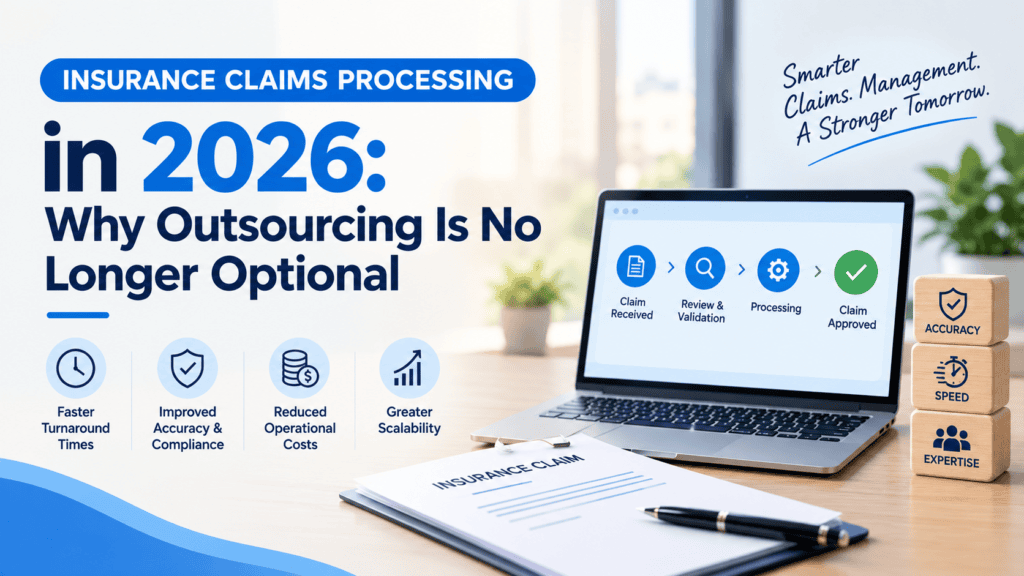
Insurance Claims Processing in 2026: Why Outsourcing Is No Longer Optional

For years, insurance claims processing outsourcing was treated as a cost-cutting move — something you did when the budget got tight, not something core to how you ran the business. That framing no longer holds. Between rising claim volumes, a retiring workforce that isn’t being replaced fast enough, tightening compliance requirements, and policyholders who now expect Amazon-level speed from their insurer, the math has flipped. In 2026, the insurers and agencies still trying to run claims entirely in-house aren’t protecting control — they’re absorbing risk they don’t need to carry. This isn’t a sales pitch dressed up as an article. It’s a breakdown of what’s actually driving the shift toward outsourcing insurance claims, what the data says about the returns, and how to think through the decision if you’re on the fence. The State of Claims Processing in 2026 The insurance BPO market’s exact size depends on which research firm you ask — estimates for 2026 range from roughly $9 billion to $17 billion depending on scope and methodology — but every major analyst agrees on the direction: sustained double-digit or high-single-digit annual growth through the early 2030s. That’s not a niche trend. That’s an industry-wide structural shift. What’s driving it isn’t just cost. A recent Insurance Operations Leaders Trends survey found that 83% of insurance operations leaders now consider outsourcing extremely or very important to their organization’s future success — a number that reflects a strategic bet, not a budget line item. Claims processing consistently ranks as the largest single service category within insurance outsourcing, because it’s the function that’s most labor-intensive, most error-cost sensitive, and most exposed to volume spikes insurers can’t staff for internally. Three forces are converging to make claims processing outsourcing 2026 less of a choice and more of a competitive necessity: Claim volumes are outpacing internal capacity.Natural disasters, expanding product lines, and higher policy penetration all push claim volume up faster than most internal teams can scale. When a major weather event hits, insurers without outsourcing partnerships face weeks of backlog; those with flexible outsourced capacity can absorb the surge without a service breakdown. The claims workforce is retiring faster than it’s being replaced.Experienced adjusters and claims examiners are aging out of the industry, and the talent pipeline behind them hasn’t kept pace. This isn’t a temporary staffing hiccup — it’s a structural gap, and insurance back office outsourcinghas become one of the few reliable ways to keep claims operations running at full capacity without a multi-year hiring and training runway. Policyholders expect digital-first, fast resolution.Customer tolerance for slow, opaque claims processes has collapsed. Insurers who can’t deliver quick, accurate decisions lose renewals and referrals — and increasingly, outsourced partners with purpose-built claims technology can move faster than internal teams still running on legacy systems. What “Outsourcing” Actually Covers in 2026 Insurance claims processing outsourcing used to mean handing off data entry and basic claim intake. That’s no longer the ceiling. Modern claims processing services now routinely include: First notice of loss (FNOL) intake and triage— capturing and routing new claims the moment they’re reported Claims adjudication and adjustment support— evaluating coverage, calculating payouts, and managing the claim through resolution Fraud detection and analytics— increasingly powered by AI models trained on historical claims patterns Document and image processing— including AI-assisted review of photos, medical records, and repair estimates Compliance monitoring and regulatory reporting— keeping claims handling aligned with state-by-state and line-of-business requirements Customer communication and status updates— managing policyholder-facing touchpoints throughout the claims lifecycle The shift from single-function outsourcing to integrated, end-to-end claims ecosystems is one of the defining trends of the past two years. Instead of managing five separate vendors for five separate tasks, insurers are increasingly working with partners who own the full claims workflow — which reduces fragmentation, improves consistency, and cuts the overhead of managing multiple relationships. The Numbers Behind the Shift If you need to make the business case internally, the data gives you real ammunition: AI-assisted claims processing is cutting cycle times by 40–60%in reported implementations, largely through automated document reading and straight-through processing that removes manual data entry from simple claims. Automation-driven claims handling is delivering roughly 30% in back-office cost savingsby reducing manual review time and human error rates on routine claims. Property and casualty insurers are specifically expanding outsourced claims adjudicationas a way to manage volume without permanently expanding headcount — a trend market analysts expect to continue accelerating through the next several years. None of these numbers mean much in isolation. What they add up to is a simple pattern: the gap between insurers using AI in claims processing through experienced outsourced partners and those still running fully manual, in-house workflows is widening every quarter — and it’s a gap measured in both cost and customer satisfaction. Why “Not Yet” Is Becoming the Riskier Choice Every insurer weighing this decision has some version of the same hesitation: control, data sensitivity, and cultural resistance to letting go of a core function. Those concerns are legitimate — but in 2026, the risk calculus has shifted in the other direction. Staying fully in-house now means carrying staffing risk you can’t easily hedge. If your senior adjusters retire faster than you can hire and train replacements, you don’t have a backup plan — you have a backlog. Outsourced partners solve this by design, since scaling capacity is their core competency, not a side effect of headcount planning. Manual processes are now the expensive option, not the safe one. When AI-powered claims adjudication outsourcing partners are processing straightforward claims in a fraction of the time at a fraction of the cost, an internal team running the same claim through manual review isn’t being careful — it’s being slow and expensive, with no corresponding gain in accuracy. Compliance complexity is growing faster than most internal compliance teams. Specialized outsourcing partners build compliance monitoring into their core service precisely because regulatory requirements vary by state and line of business and change often. Trying to track that internally, on top of running claims volume, spreads your compliance team thin in


Read more
insurance-verification

How to Make Insurance Verification Easy for Your Clients

Have you ever had that sinking feeling when a client says, “Will my insurance pay for this?” Or worse, you only find out after the service is provided that their coverage isn’t what you thought it was? This is a common pain point in every industry, but particularly in healthcare. Trying to navigate through a jungle of insurance verification documents, policies, deductibles, co-pays, and eligibility can be a misappropriation of your time, dollars, and your client’s trust! But imagine, if you could make that entire process, dare we say, fun? Or, at the very least, truly seamless? This is more than avoiding denials, it’s about creating an easy, stress-free experience for your clients right from the first point of contact, and ensuring compensation for your business is easy and timely. Let’s dig in on how to create a seamless insurance verification process. Why a Seamless Insurance Verification Process is a Game-Changer A seamless insurance verification process is not only seen as busywork; it is a key factor to both your client experience and your financial health. Here are the benefits that make it a game-changer: Best Practices for an Easy Insurance Verification So, how do you turn a potentially messy process into a truly seamless insurance experience? It’s just about using some savvy and the right resources: MCKIOL: Your Partner for a Stress-Free Insurance Verification Process While these preferred practices may seem simple they can be difficult to do consistently and while doing your core business. The amount of time spent on manual calls, logging into payer portals, and trying to find out where the missing information is coming from is very time-consuming for in-house employees. MCKIOL is here to help. We are your expert outsourcing partner that will turn the insurance verification process from being a bottleneck to smooth sailing. We are an extension of your business, performing all of the intricacies of eligibility verification efficiently: Conclusion At MCKIOL, we recognize that a seamless insurance verification process is key to client satisfaction as well as the overall financial success of your organization; hence, our commitment to outsourcing services to help you operate efficiently and effectively without worry. Just as our partners, KHP REMOTE FTE help businesses create high-performing remote teams in everything from a myriad of career functions, MCKIOL provides the operational support for service providers to successfully develop processes to optimize their growth in their particular market. If you want to remove billing headaches and provide your clients with a truly seamless insurance experience, stop letting the verification messiness slow your team down. Contact MCKIOL now for a chat about how our outsourced expert services can simplify your insurance verification process and impact your bottom line! Check out our other blogs, i.e., That Insurance Headache? Here’s How to Finally Fix It.

Read more

That Insurance Headache? Here’s How to Finally Fix It.

You know that feeling, right? That slow-dread feeling when a new insurance claim lands on your desk. You look at the first page and you just know it’s going to swallow your entire day, if not your week. It’s one of the biggest headaches in business. A business owner I was talking to last month put it perfectly. He said, “It feels less like I’m running a company and more like I’m a detective in a cheap novel where the last ten pages have been ripped out.” You’re trying to connect the dots, but the clues are a mess, and the clock is ticking. That’s the core of the problem. It’s not just paperwork. It’s a direct hit to your finances, your customer loyalty, and your team’s sanity. Getting it right isn’t just a back-office task; it’s a critical part of a healthy business. Let’s Get Real: Why is This Whole Process So Painful? It’s not just one thing; it’s a perfect storm of frustrating little tasks that build into a massive problem. First, you’re hit with an avalanche of information. Every single claim comes with a flood of details—policy numbers, incident reports, photos, medical records, you name it. Just trying to keep it all straight without losing your mind is a full-time job in itself. Then comes the mountain of paperwork. It seems like every type of claim has its own unique set of forms, and each one is a potential landmine. You put one number in the wrong box, and the whole thing can get delayed for weeks or just flat-out denied. After you have the information, you have to make the tough judgment calls. Is this claim completely legitimate? What’s a fair payout? You’re constantly walking this tightrope between doing right by your customer and protecting your company’s finances. It’s a heavyweight. All the while, you’re fielding non-stop questions. Your customers are anxious. They want updates, they need answers, or sometimes they just need someone to talk to. And they deserve that! But being there for them, day and night, can stretch any team thin. And sometimes, you have to chase down payments. It’s a delicate dance, trying to be firm enough to get paid but gentle enough that you don’t burn a bridge with a client you want to keep. Finally, you have to get the billing right. When the dust settles, the final invoices have to be perfect. One mistake here and you’re right back where you started, untangling a whole new mess. The Real-World Cost of a Broken Claims System When these steps go off the rails, it’s not just an annoyance. It’s a series of body blows to your business. There’s a Better Way Than “Just Grin and Bear It” So what’s the answer? You don’t have to just accept this as the cost of doing business. The real secret is to hand the headache over to someone else—someone who actually enjoys this work. When you partner with an insurance outsourcing team, you’re not just shuffling tasks around. You’re making a strategic decision to: Why MCKIOL Is Your Best Bet At MCKIOL, we get it. We understand how messy and critical this process is. We aren’t just another vendor; we’re the partner you call when you want this entire problem to just go away. Our team handles everything—from sorting the data and filling the forms to making the tough calls and answering your customers’ calls, day or night. We are laser-focused on saving you money, speeding everything up, keeping you compliant, and making sure your data is secure. But more than anything, we’re here to help you give your customers the kind of service that makes them loyal for life. With our proven process and smart tech, we take the stress out of the claims game so you can get back to being the leader in your industry. Ready to make a change? Let’s connect and see how we can take this entire mess off your hands for good.

Read more
Contact us

Partner with us for Comprehensive Outsourcing Services

We’re happy to answer any questions you may have and help you determine which of our services best fit your needs.

Your benefits:
What happens next?
1

We Schedule a call at your convenience 

2

We do a discovery
and consulting meeting 

3

We prepare a proposal 

Send Us Your Queries
Please enable JavaScript in your browser to complete this form.
Name